
home | image | text | sound | extra | lorem ipsum | about this site | about me
lorem ipsum, or the theoretical statement

This section of the collage has images from the original word puzzle, but the clues (NADA = nothing, and DIOS EGIPCIO = Egyptian God) come from a different puzzle.
Introduction
One of my passions—probably obsessions—is to solve Spanish crosswords and sudoku puzzles. I have been solving crosswords from Spain—known as autodefinidos, or “self-defined,” since I was 12-years-old. Whenever I need to relax either because I have a paper to write or a test to take, I calm down by solving a puzzle. I have solved a few New York Times and USA Today crosswords, but I still need to know more words and have more information about the English language and its cultures. I do not want to use a crossword dictionary every time. Although I have lived in the United States since August of 1993, I have spoken more Spanish than English because I am a Spanish instructor.

Photo of an autodefinido
Sudoku, or the crossword with numbers only (?), has taken the place of autodefinidos for a few years now; in part because buying Spanish magazines in Virginia is expensive, besides sudoku is free online and it is published in almost every newspaper. Unlike the word puzzles, sudoku is very “mechanical” and logical. This “mechanical” aspect allows me to think about something else while trying to solve a sudoku crossword. Sudoku is a symmetrical puzzle created with a proprietary software, which makes me believe for a moment that solving one means being kind of a cyborg.

sudoku
In February of 2009 I discovered William S. Burroughs’ visual art and I was fascinated by the similarities between a failed—or “in progress”—crossword and a Burroughs’s cut-up. William S. Burroughs and Brion Gysin created the cut-ups when they were in Paris and they used newspapers, photographs, hieroglyphics, the typewriter, handwriting, comic books, and other already available materials. These cut ups are the equivalent of the “ready-mades” by Marcel Duchamp.

Cut-ups are somehow palimpsestic and hypertextual, oulipean and combinatory writing at the same time. In my e-portfolio, I wanted to have a combination of pictures, pictograms, hieroglyphics, text in small boxes or out of the boxes, as well as some elements that would look like they were erased and something else was written on top of them—just like a crossword in progress.
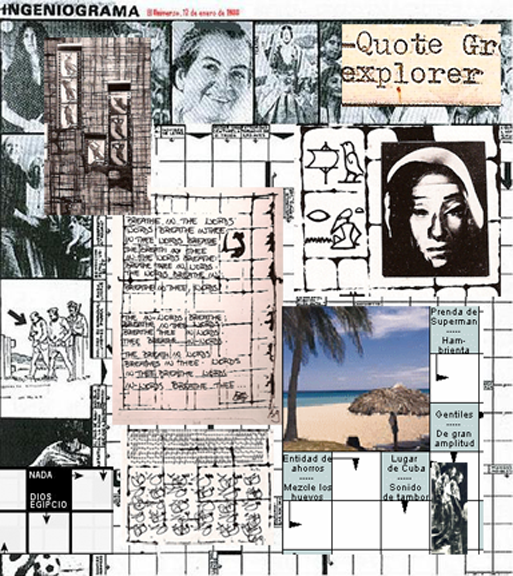
Main page photo
The first version of this portfolio [ click here], had an artist statement instead of a theoretical statement and it was called “Lorem Ipsum,” which is known as the dummy text that book printers and web designers use to mock up a page. It seemed very difficult to write about theory before having the site ready and Lorem Ipsum was the most appropriate title at that moment. After a few months, I redesigned the whole portfolio, but instead of working from theory to web page details, I started from a detailed style sheet for the web page [see sytle sheet here] and then built up the site.
The old site is included here, because it shows part of the process of building the meaning and ideas for the new site. After completing all the pages, except for the Lorem Ipsum, I went back to the artists statement and this is the result. However, there are several possible questions that I need to answer to my readers and of course to myself. Since my prose skills in English are not as decent as my skills in Spanish, this process has resulted in frustration and a “lapsus brutus” (a lapsus of stupidity in Mexican Spanish)—after every paragraph—theory is not a cold text that one produces in a lab, or after a cup of coffee; theory is poetry, art, images, and logic, logic, logic; and for that one needs to write in the language or languages that one knows better. But in order to be understood, I need to present clear concepts and ideas.
Up to this point, you have read about the conceptional and creative process of this site, but nothing about theory. Taking a hint from the crossword dictionaries and the FAQ pages of large sites, I decided to provide the theoretical information in using the Q&A format. A question from an imaginary reader and my best answer.
Questions & Answers
Q1. Why did you chose to use crosswords and puzzles in your e-portfolio instead of books?
A1. Crosswords and puzzles are similar to books and theory in general. In order to solve a puzzle, the “reader” needs to have an average or above average knowledge of general history, literature, politics, chemical symbols, and popular culture, while a book reader is a puzzle solver, even if the book is about how to solve puzzles or how to read a book. Also, a book reader interacts the book as an artifact and a series of ideas, just like the puzzle or crossword solver.
Q2. You need to talk about theorists studied during the first three semesters of the MATX program, aside from Burroughs, Gysin and Duchamp, what other theorist can you connect to the conception of your e-portfolio?
A2. In general, I believe that my portfolio is a bricolage, which already qualifies it as a postmodern piece, therefore Lyotard, Baudrillard and all the French thinkers can be an inspiration. More specifically, this portfolio is connected to the ideas of Roland Barthes, Jacques Derrida, and Ted Nelson.
Q3. Why Roland Barthes?
A3. Because in “The Death of the Author” Roland Barthes states that there are no original texts, since each text is just a collection of phrases that belong to the writer or scriptor and the reader. A puzzle, either with words, numbers or images, it is not complete until the reader or puzzle solver writes or puts down the last letter/number/piece to reveal the author’s enigma, which cannot be too obscure or too transparent for the reader, but it has to have a viable solution. Also, in S/Z, Barthes explains that the reader has to be a producer of literature, which makes him or her an author. Barthes is also a reference to some of my photos, for example, the close ups of the caterpillar, the snail, and the worm have a punctum, which is the fact that the spectator can see their eyes and a expression that resembles an emotional state. [see the photos here]
Q4. Why do you think Derrida is related to puzzles?
A4. In “Structure, Sign, Play” Derrida mentions that there are two interpretations of interpretations and signs, and there is always room for freeplay. In a crossword puzzle the fun part is when there are two or more meanings of the same word and one of them is a play on words, or happens to be the most obvious answer instead of the most obscure and serious answer. Also, the bricolage in the home page--made with other people’s materials--and the design of the site have more meaning in this theoretical statement than all the work that I have produced and added to the e-portfolio.
Q5. Why did you mention Ted Nelson?
A5. Because Nelson says that everything we present is a show. In this theoretical piece I cannot just talk and suggest that there is a connection with this or that philosopher, I also have to show that the colors, organization, etc., have a purpose, which is that of presenting an online narrative, or hypertext.
Q6. Why did you include a photo with your name handwritten on it?
A6. Handwriting is part of solving a word or number puzzle. Also, because I feel the need to rescue my own handwriting. There are days in which I do not use my hands to write on a piece of paper, except when I’m solving a sudoku puzzle. In the last three years I have used my hands more to type, draw and take pictures than to write on a piece of paper.
Q7. Do you believe that your theoretical statement is actually a lorem ipsum, or a dummy text?
A7. No. In my opinion, lorem ipsum is never dummy text, because it is text with a purpose and that purpose changes with every design, every page. Lorem ipsum is a verb that has a visual meaning and also a time-limit existence—it is there in the meantime; it a text waiting to be changed, even if sometimes it is waiting for Godot. Lorem ipsum is the ever changing Lacanian text, the one that fills the language gaps and makes a web page flow before it is completed. Lorem ipsum is the incorrect word or number that keeps the faith of solving a crossword alive.

